

saftabee
Childrens Beekeeping Gloves | 100% Sting Protection Ventilated | Safta Bee
products.product.pickup_availability.unavailable
Children's Beekeeping Gloves | Beekeeper Gloves Thick Cowhide Leather | Tear-Resistant, Soft & Durable
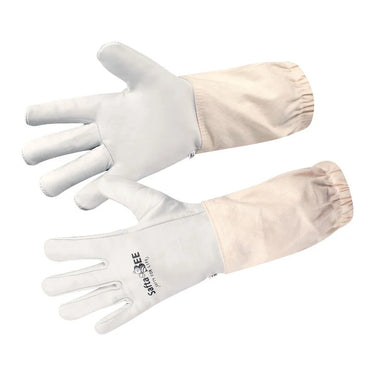
These Children's Beekeeping Gloves are crafted from thick cowhide leather, professionally tanned using chrome-free technology to protect young hands from skin irritation and allergies. At 0.8mm thickness, the leather offers reliable protection against bee stings without sacrificing comfort, making these gloves ideal for young beekeepers learning to work safely around the hive.
Sting Protection
Our kids' beekeeping gloves combine thick cowhide leather with long, sturdy poly cotton sleeves to shield the arms as well as the hands. The genuine leather construction is dense enough that a bee's sting cannot penetrate the glove, giving parents and young beekeepers peace of mind during hive inspections.
While lighter cowhide gloves offer more dexterity — allowing children to handle bees more carefully and reducing the risk of accidental stings — these gloves strike the right balance between flexibility and protection, so kids can work comfortably and confidently.
Comfortable & Durable
Made from soft, supple cowhide leather, these gloves offer a snug, secure fit. A poorly fitting beekeeping glove makes hive work harder, increases clumsiness, and raises the risk of squashing bees or getting stung — so we've designed these with a proper fit for smaller hands in mind.
Ventilated Ergonomic Design
Each glove features a long, fully vented poly cotton sleeve that stays cool even during extended wear, preventing overheating on warm days. A well-ventilated, well-fitted glove keeps hive work easier and safer, reducing clumsiness and the risk of stings.
Your child will stay cool, comfortable, and safe while working with the honeybees, with ventilation that prevents overheating without compromising sting protection.
30-Day Replacement Policy & UK Dispatch
All orders are shipped from the UK, ensuring fast, reliable delivery. We back every pair with a 30-day replacement policy — if there's any issue with sizing, fit, or quality, simply get in touch and we'll sort out a replacement quickly and hassle-free.
100% Satisfaction Guaranteed
We provide dedicated, professional customer service before and after your purchase. If you have any questions or concerns about your Children's Beekeeping Gloves, our team is on hand to help.
Key Features
- Thick cowhide leather construction
- Chrome-free, allergy-conscious leather
- Fingers individually cut and stitched for durability
- Poly cotton mesh ventilated cuff for breathability
- Poly cotton upper arm sleeve
- Elasticated upper arm closure for a secure fit
- 100% sting-proof cuff
- 30-day replacement policy
- Shipped from the UK
Frequently Asked Questions
How do I clean beekeeping gloves?
Wash the gloves using a mixture of warm water and hand soap or a mild detergent. Soak overnight in cold chlorine water to loosen dirt and remove stains, then rinse thoroughly and air-dry in the sun.
Can leather beekeeping gloves be washed in a washing machine?
Leather is durable and can withstand regular washing, but avoid machine washing. Hand wash and be careful when using cold chlorine water to protect the leather's finish.
Do these gloves come with a guarantee?
Yes — every order includes a 30-day replacement policy, and all items ship from the UK for quick delivery.
Are these gloves suitable for beginner young beekeepers?
Yes — the snug fit, ventilated sleeves, and sting-proof cuff make them a great choice for children just starting out in beekeeping.

Sizing Guide
How to Find Your Ideal Size
The size is very important when selecting Safety Gears. We have tried to explain the way you may find the suitable product for you. All our sizes are Standard Sizes according to UK. Yet, because of some heavy fabrics and other material your size may change from the one you normally use. Bee suits are therefore designed this way, to be fitted enough, not to be bulky, awkward, and roomy enough to move, even with a honey belly.
Unlike regular everyday clothing, the fit of a beekeeping apparels needs to be loose to give you ample room for your body to move around during beekeeping.
A loose fit will also have the added bonuses of creating gaps between you and the fabric of the suit; that will make it hard for bees to make contact with your skin, thus sting you, and to allow air to flow through the suit and helping to keep cool.
Before purchasing an item from the website, it is always a good idea to properly measure yourself. The most important aspects of beekeeping to measure are
- Take measurement of your chest
- Take measurement of your back
- Take measurement of your arms
- Take measurement of your waist
- Take measurement of your height
After measuring yourself, go to our Standard Size Chart and see which size would be fit for you.
Still, if you have any questions or need more information about choosing the correct size for you, please contact our Customer Care Service at customercare@saftabee.com.
SAFTA Beekeeping Suit Size Guide

SAFTA Beekeeping Jackets Size Guide

Kids Beekeeping Suit Size Chart:

Product information
Kit should fit the hand of the keeper.
If yours doesn't, send it back. Sixty days from the day it arrives. No reason needed.
In short.
You have thirty days from the day your parcel lands to change your mind and send it back. That's longer than the law requires; we keep it that way because a beekeeping suit deserves a season's testing, not a fortnight's. Faulty kit is repaired or replaced free of charge under the Consumer Rights Act 2015 - without a quibble in the first thirty days, and without a quibble at all in our experience.
We mend what we made, and we refund what we cannot mend.
How to send something back.
Open the returns portal at [CONFIRM: returns portal URL], or write to [CONFIRM: returns email] with your order number. We will email a returns form and the address.
Who pays the postage.
For a change of mind, you cover the return postage. For anything faulty, we cover it. There is no trick here: we send a prepaid label by email.
When you'll see your money.
We refund within fourteen days of the parcel reaching the workshop, by the same payment method you used. If you used Klarna, the refund returns through Klarna; if you used a card, the card.
Your statutory rights and the rest of the policy
Your right to change your mind (Consumer Contracts Regulations 2013).
You have a statutory 14-day cooling-off period from the day you receive the goods. We extend that to 30 days as our policy. To cancel, tell us by email, post, or the returns portal - or use the model cancellation form below. You don't have to use the form. After cancelling you must return the goods within 14 days. We will refund all payments received including standard delivery, within 14 days of receiving the goods or proof of postage, by the same means you paid.
Items excluded from the change-of-mind right (Reg 28).
Truly bespoke items made to your individual measurements; sealed-for-hygiene items once unsealed. Picking a stock size from a chart is not bespoke - those returns are accepted as normal. We will tell you clearly before you order if an item is excluded.
Faulty or misdescribed goods (Consumer Rights Act 2015).
Within 30 days of delivery you have the short-term right to reject for a full refund, no deduction for use. Between 30 days and six months we will repair or replace free of charge; if that fails, you can have a price reduction or a final refund. In the first six months the law assumes any fault was present at delivery, so the burden is on us to prove otherwise, and that's how we treat it. You will never be out of pocket on return postage for a faulty item.
Diminished value.
We may deduct from the refund where you have handled the goods beyond what's needed to check their nature, characteristics and functioning. In practice that means: trying a suit on indoors is fine; wearing it for a hive inspection is not.
Model cancellation form (you don't have to use it).
To: [CONFIRM: legal entity, address, email]. I/We hereby give notice that I/We cancel my/our contract of sale of the following goods: ......... Ordered on / received on: ......... Name(s): ......... Address: ......... Signature (paper only): ......... Date: .........
Statutory rights.
Nothing in this policy affects your statutory rights under the Consumer Rights Act 2015 or the Consumer Contracts (Information, Cancellation and Additional Charges) Regulations 2013.
Two minutes after a hive inspection. Twenty minutes at the end of the season. That's the bargain.
In short.
Brush off propolis and pollen before it sets. Wash cool, dry slow, and never tumble what was woven to breathe. Leather wants oil, not water. Mesh wants air, not heat. Veils want a hook, not a hanger.
The keeper who minds the kit minds the bees better.
Ventilated three-layer suits and jackets.
The mesh is the protection - protect the mesh. After each inspection, brush the suit down with a soft bristle brush to lift propolis, wax flecks, and pollen before they fuse to the fibre. Stings left in the cloth should be plucked out the same day.
Wash: machine, cold or thirty degrees, gentle cycle, mild non-bio detergent. No bleach. No fabric softener. Zip the veil closed, fasten all velcro, turn inside out.
Dry: air dry, flat or on a wide hanger, out of direct sun. Never tumble dry - heat collapses the spacer fabric and the loft will not return.
Cotton suits and jackets.
Cotton forgives more than mesh. Brush off debris, then machine wash at thirty to forty degrees, non-bio detergent. White cotton tolerates colour-safe oxygen brightener once or twice a season - chlorine bleach, never. Air dry where possible; tumble on low if you must.
Veils.
Treat the veil like optical equipment, not laundry. Hand wash only, lukewarm water, drop of mild soap. Press, do not wring. Air dry over a wide hook or upturned bowl so the crown holds shape. Never fold a stiffened veil flat - the crease will not come out.
Detach fencing veils before washing the suit body. Hooded veils that don't detach age faster than the rest - that's the trade.
Leather bee gloves - cow, sheep, goat skin.
Leather is skin. Wipe down with a damp cloth after a heavy day. Once a month in season, condition with neatsfoot oil, mink oil, or saddle soap, worked in by hand and left overnight.
Do not machine wash leather gloves. Detergent strips the natural oils and the glove goes hard, brittle, and a size smaller. If truly filthy, hand wash quickly with cool water and saddle soap, reshape, condition while still damp.
Goat skin is softest and dries fastest - condition more often. Cow leather is toughest. Sheep skin sits between.
Gardening, Kevlar, and thorn-resistant gloves.
Most gardening gloves with cotton or synthetic backs and leather palms can be machine washed cool, gentle cycle, mild detergent. Air dry only - tumble drying weakens Kevlar stitching over time. All-leather rigger gloves: follow the leather routine - wipe, condition, no soaking.
Welding gauntlets and heat-resistant gloves.
These do not get washed. Water and soap break down the heat-resistant treatments and the Kevlar lining. Brush off debris, wipe leather with a barely-damp cloth, condition lightly once a season. Store flat, out of sunlight - UV degrades both leather and Kevlar.
Heavy oil or grease stains on a welding gauntlet? Accept them. The leather is doing its job.
Storage between seasons.
Wash and fully dry everything before winter. Hang suits and jackets on wide hangers in a breathable cotton garment bag - never plastic. Store gloves loose in a drawer, not stacked. Veils on a hook, never folded under weight. A cedar block or dried lavender keeps moths off the cotton.
Kit put away well in October is kit ready in March.Stains, repairs, and what not to do.
Propolis.
Freeze the garment first - propolis goes brittle below zero and chips off with a fingernail. What remains, dab with surgical spirit on a cotton bud, working from outside the stain inward. Then wash as normal.
Honey and wax.
Honey rinses out warm before it dries. Once dry, soak ten minutes in warm water then wash. Wax: scrape off what you can, then iron the residue between two sheets of brown paper - the heat lifts it into the paper.
Sting venom and small holes.
Venom yellows white cotton and weakens fibre - wash the day of the sting where you can. A small hole in mesh is serious; it is a route for stings to reach skin. Send it to us - we patch mesh suits at cost in the first year, material cost thereafter. Do not repair mesh at home; needle holes become weak points.
Zips and velcro.
Brush wax and propolis from zip teeth with an old toothbrush, then run a graphite pencil along the closed zip - dry lubrication that doesn't attract dust. Velcro that has lost grip is usually full of fibre - pick it clean with a needle point or comb gently.
What not to do.
No bleach on coloured cotton or any mesh. No fabric softener on ventilated suits. No tumble drying anything three-layered. No machine washing leather. No drying on a radiator - direct heat shrinks cotton and warps mesh. No storing damp - mildew destroys a suit faster than a hot wash.
When to retire a piece.
Mesh: when daylight shows through panels that shouldn't, or cuffs lose grip. Cotton: when fabric thins enough a sting could pass doubled cloth. Leather gloves: when the palm goes shiny-smooth, seams open, or leather stays stiff despite conditioning. Veils: at the first crease that won't smooth, or the first hole however small.
Honest counsel.
Send a photo to [CONFIRM: care email]. We'd rather repair than replace, and rather replace than have you working a hive in failing kit.
Recently viewed products
Describe your recently viewed products here